Essay on Impact of Online Reading on Printed Books
How well do your students learn when they read online? What are the outcomes of on-screen reading compared with reading in print?
Implications from electric current research
Current research suggests that reading online results in lower agreement and less disquisitional reflection. What might this mean for our students' learning and for society?
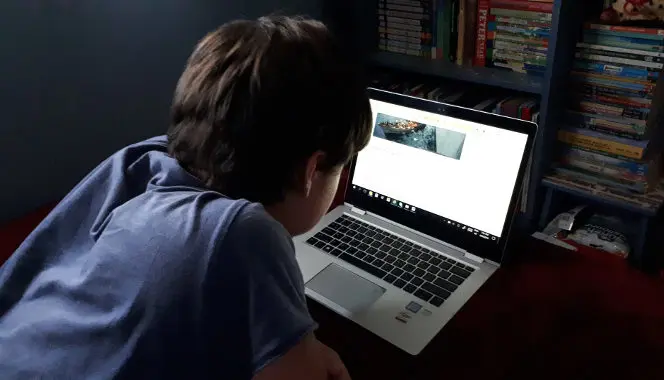
I read differently online but what about our students?
I spend a lot of fourth dimension in front of my laptop reading for research. Merely when I'thousand reading for pleasure, I normally grab a impress book.
I've noticed that my reading is quite different when I'm online. I skim the text quickly, looking for keywords that might relate to what I'm researching rather than settling in for a long read. I oftentimes impress online articles so that I tin can read them in hard copy considering I find that easier to concentrate on.
For our students who are growing up in a digital world with all its advantages and distractions, I wondered what reading practices have adult to deal with the online globe and what their consequences might be.
Online and connected
The online world is vast and in that location is no sign of information creation slowing down. Our digital feel is enhanced by media-rich content and quick links to other sites, offer convenience, flexibility of approach, and oftentimes cheaper costs than print materials. We have instant knowledge of world events and everyone's reaction to them and can, in turn, instantly react and contribute ourselves.
But non all of this information is unbiased or even relevant to our needs, and the speed at which events are reported gives us little fourth dimension to evaluate sources, think critically or engage in considered reflection. As Susan Greenfield, a neuroscientist from Oxford University, comments in her 2014 interview with ABC's Gary Rivett:
The issue is that information isn't knowledge. Of class, you can be bombarded with endless information, endless facts only if you tin't make sense of them, i fact is the same equally whatsoever other fact. You can prowl on YouTube or on Google going 'yuck' and 'wow', but you lot're not actually making sense of things.
Digital content — finding, evaluating, using and creating it
Adapting to a fast-paced world
In 2018, journalist Sally Blundell interviewed neuroscientist Maryanne Wolf for The New Zealand Listener. As Blundell and Wolf note:
'Generally, reading on a screen encourages multitasking, a unlike class of attention, a different speed of processing'. And if people are skim, skim, skimming, she tells the Listener, 'and not going deeper to understand the complexity of bug, they will be far more attracted to fake news or worse'. In that location is business organization, she says, that digital media and the sheer volume of online information and communication invite the fast and shallow read. The result, she writes, is more and more young people non reading other than what is required, 'and often non fifty-fifty that: "tl; dr" (too long; didn't read)'. (2018, Oct)
Researcher Ziming Liu also notes that:
...screen‐based reading behavior is characterized by more time spent on browsing and scanning, keyword spotting, one‐time reading, not‐linear reading, and reading more selectively, while less time is spent on in‐depth reading, concentrated reading and decreasing sustained attending.
The issues are more compelling for even younger students as their adaptation to a fast-paced digital world may be changing their brains and influencing their ability to develop these skills. The very plasticity of our encephalon — the ability to respond and adapt to our environment and its challenges — that has kept our species live for millennia also encourages it to take on the characteristics of whatsoever medium it is reading on.
If you have a young brain with the evolutionary mandate … to adapt to the environs, and the brain is placed in an environment that is very fast-paced, requiring a little attention bridge where you move onto the next thing … the brain volition obligingly arrange to that. And and so you put that same child in an environment where it has to concentrate for a long period of time it won't have rehearsed that skill. Therefore it won't be very good at it.
— Susan Greenfield, Engineering and the Human Mind (YouTube video, 23:23), TEDxOxford
So, do our digital reading practices foster the reflection and deep reading necessary to evaluate and respond thoughtfully to and then much information and information?
Comparison impress and digital reading
In Naomi Baron's 2017 commodity, Reading in a digital historic period, her review of related enquiry included a 2011 study by Ackerman and Goldsmith. This study noted that when students take a option, they spent less time on digital reading, and had lower comprehension scores. Schugar et al (2011) constitute that participants reading on-screen used fewer study strategies such every bit note-taking. Baron's article besides cited more than recent enquiry by Kaufman and Flanagan (2016) that constitute that students reading digitally did well on answering physical questions. Even so, those reading in impress did ameliorate on abstract questions needing inferential reasoning.
In Baron'due south own enquiry betwixt 2013 and 2015 of more than 400 academy students from five countries, 86% preferred reading longer texts in print and 78% when reading for pleasance, with 92% saying it was easiest to concentrate when reading print. 85% of the US students were more likely to multitask in an online environment and only 26% when reading print.
New Zealand researchers Hooper and Herath (2014), in their report Is Google making us stupid? The impact of the internet on reading behaviour, determined that the impact of the online environment on academy students' reading included:
- increased corporeality of reading due to the growth of online material
- improved speed of reading
- improved skimming ability.
The impact as well included:
- change in patience as readers
- multitasking
- distraction
- eye strain
- scanning rather than reading through (in print 82% of participants read from commencement to end).
Reich, Yau and Warschauer (2016), in their study on using tablet-based eBooks with very young children (0–ii years), commented that enhanced eBooks with sounds, animations, and games can distract children and reduce learning. When book-sharing with an developed, conversations during eBook reading are oftentimes nigh the platform while print book conversations are more than oft about the book content.
Careful design can make a difference
Interestingly, these same researchers have also found that with eBooks that are carefully designed to support reading rather than distract with features that are simply entertainment, the children's comprehension of a story was at a similar level.
Additionally, eBooks and digital applied science can exist very engaging for reluctant readers. The National Literacy Trust's 2015 study of children'due south access to eBooks institute that:
...boys' reading levels increased by an average of 8.4 months, compared to vii.2 months' progress made by girls. Furthermore, the percent of boys that felt reading was difficult almost halved from 28.0% to xv.9%, suggesting that conviction in their own reading ability increased as a result of the project. In addition, the percentage that felt reading was cool rose from 34.4% to 66.v%.
Reluctant readers
A contempo literature review (2021) of 14 studies on the effect of ebooks on children'southward reading by López-Escribano, Montesino, and García-Ortega, notes that 'when e-books are properly selected and used, children develop literacy skills equally well and sometimes better than with print books'. The authors also noted that:
...children living in a deprived context, at risk of learning disabilities, and English language Linguistic communication Learners benefited from all the reviewed e-book interventions, which highly improved their literacy skills, regarding concepts near print, phonological awareness, vocabulary, and reading comprehension. Digital learning and e-book reading represent a potential compensatory strategy for these children.
Best of both worlds
Both print and online reading are thoroughly established in our students' daily lives.
Online reading has evolved to permit the quick perusal of a lot of information very apace — a bang-up strategy for scanning through e-mail for example.
In Businesswoman's article near her 2013–2015 inquiry, she reports that participants:
...praised digital reading on a number of counts, including the ability to read in the dark, ease of finding textile ('enough of quick information') saving paper and even the fact they could multitask while reading.
She also reports that the students in her study commented that print was aesthetically more enjoyable ('I like the smell of newspaper') and that print gave them a sense of where they were in the volume — they could see and feel where they were in the text.
Students in Scholastics' 2012 Kids & Family unit Reading Study say that eBooks are better than impress books when they practice non want their friends to know what they are reading, and when they are out and about travelling. Print is better for sharing with friends and reading at bedtime.
Wolf, in her The New Zealand Listener 2018 interview, noted that print reading allows us to slow down and give time to sophisticated deep reading processes, letting united states discern truth, employ disquisitional analysis, gauge inference, develop empathy, appreciate beauty to attain the knowledge and wisdom necessary to sustain a good society.
Then it's not an either/or choice
Instead, it's a matter of how we get the all-time out of both impress and on-screen. Wolf, in her 2018 RadioNZ interview, suggests that nosotros demand to teach our students which medium all-time suits the purpose for which nosotros are reading. Her best promise for our reading futurity is the 'bi-literate' brain — one that uses the optimal skills of each reading style so that students can read deeply equally well online as in print.
Find out more than
Engaging teens with reading — find inspiration and strategies to encourage teens to read for pleasance.
2019 Enquiry: Reading in a Digital Age — by Read NZ Te Pou Muramura.
Reader Come Home: The Reading Brain in a Digital World — 2018 book by Maryanne Wolf.
Reading on paper versus screens: What'due south the difference? – July 2020 article by Kerry Benson.
Skim reading is the new normal — Maryanne Wolf (2018) in the Guardian.
What works better for memory — printed or digital texts? May 2021 commodity by Naomi Baron.
Reference
Blundell, Southward. (2018, October). Dearest Reader. The New Zealand Listener 85(4088) 13–xix Oct 2018.
This blog postal service
This blog post was first published in March 2019, and was last updated and republished in Oct 2021.
Essay on Impact of Online Reading on Printed Books
Source: https://natlib.govt.nz/blog/posts/reading-on-screen-vs-reading-in-print-whats-the-difference-for-learning
0 Response to "Essay on Impact of Online Reading on Printed Books"
Post a Comment